
Something changes the first time you see a fourteen-year-old describe biodiversity loss to a group of adults. The talk no longer seems like a school assignment to you. You begin to perceive it as a silent, real-time inheritance dispute. That is the peculiar, optimistic tone of what is currently taking place in community centers, schools, and olive groves. Young people are no longer waiting to be included in discussions about climate change. They just strolled in.
In March 2023, the Erasmus+ project “Way to Go Against Climate Change” brought together young workers from all over Europe on Réunion Island, a volcanic dot in the Indian Ocean. There was no sterile conference room used for the training. It took place on an island where storms and rising temperatures aren’t hypothetical, and the coastline itself serves as a sort of evidence file. Participants returned with new perspectives. Working with the French group Together for Youth, one of them came back to the mainland and started a program called Climate Circles, which are small workshops in community centers where teenagers discuss plastic, fast fashion, and food waste without anyone watching from a slide deck.
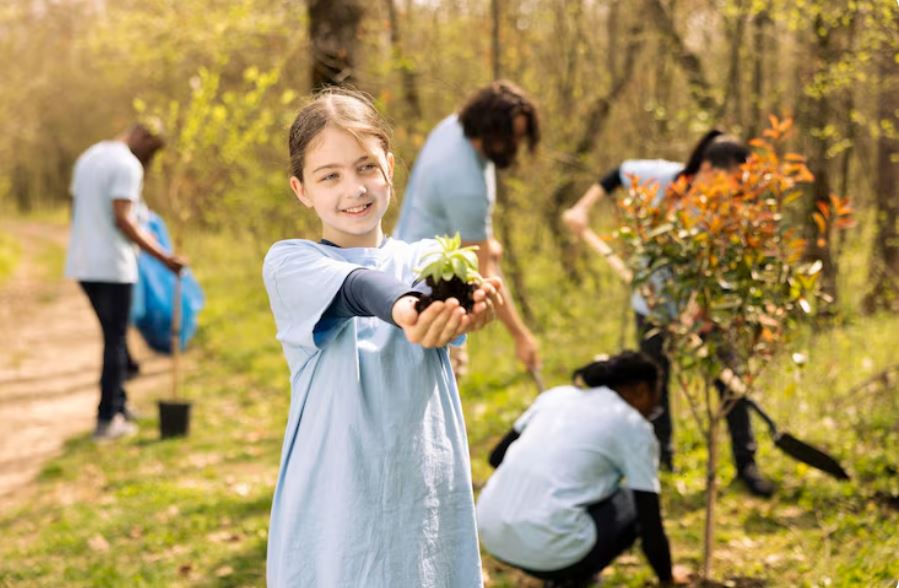
Observing this type of work gives the impression that the outdated approach to climate education has quietly run out of steam. The needle has not been moved by lectures. When statistics are repeated frequently enough, they begin to sound like background noise. Sitting in a circle, telling stories, and engaging in seemingly insignificant games—until you see how much the children remember afterward—seems to be what truly works. Instructors in France have reportedly observed students starting eco-clubs on their own initiative. That is not insignificant. That’s the distinction between being aware of an issue and experiencing personal responsibility for it.
The picture becomes even clearer in the West Bank, across the Mediterranean. Children in places like Hebron and Jericho are being exposed to their own land in novel ways through the Green Palestine project, which is managed by World Vision in collaboration with the MA’AN Development Center. Over 2,700 children have visited thirteen villages thanks to a mobile museum created in collaboration with the Palestine Institute for Biodiversity and Sustainability. Organizers were informed by Yamen, a fourteen-year-old from one of those communities, that he had seen butterflies that he was unaware of. It’s a short line that’s simple to scan. It’s also the whole point.
A subtle rejection of the notion that environmental consciousness is a luxury topic is what connects Réunion to both Ramallah and the rooftops of urban France. An awareness of the triple planetary crisis—biodiversity loss, climate change, and pollution—is not optional for a generation growing up in these circumstances. It is more akin to self-defense. The number of young people worldwide is estimated by the UN to be 1.2 billion and growing. They are aware that the decisions made over the next ten years will determine how long they live.
Whether mobile museums and grassroots circles can grow quickly enough to have an impact at the policy level is still up for debate. Most likely not by themselves. However, there is merit to the fact that thousands of kids are now characterizing themselves as gardeners of hope rather than inheritors in places that hardly ever make headlines. As this develops, it’s difficult not to feel that the seeds—both the actual ones in the ground and the metaphorical ones in the discussions—are accomplishing more than the majority of adult institutions at the moment. Now, someone else is responsible for the harvest. And someone else appears prepared.