
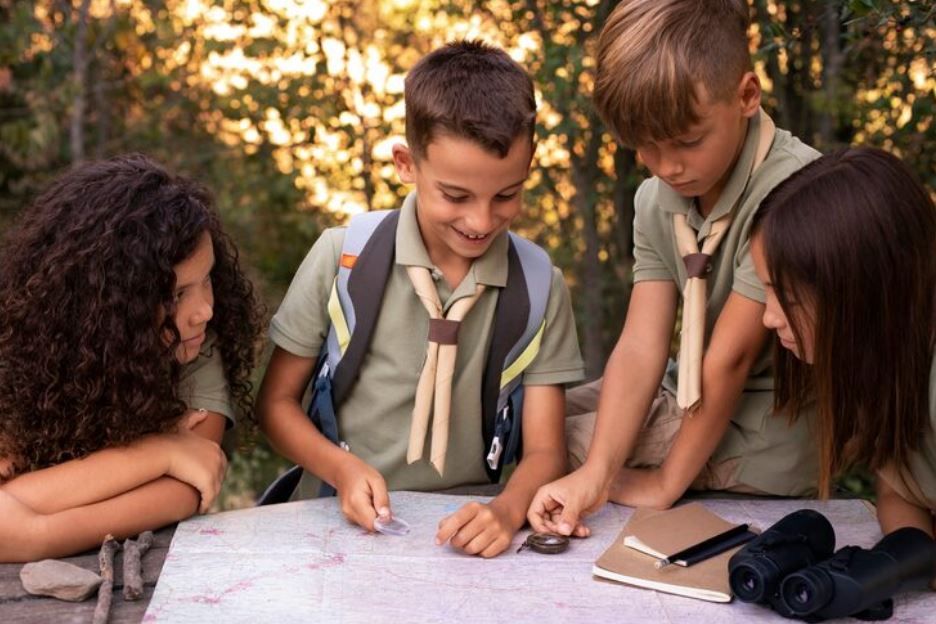
Children’s learning and teachers’ teaching methods are starting to change due to the quiet pulse of outdoor education. Chalk dust and fluorescent lights have been replaced by the clean air, the steady rustle of trees, and the endless curiosity it arouses. Outdoor learning has developed into something incredibly human in schools and educational institutions, teaching kids how to feel, notice, and connect in addition to what they should think.
Fundamentally, outdoor learning questions the notion of what a classroom ought to look like. For some, it’s a school courtyard turned into an imaginative laboratory; for others, it’s a forest full of whispering leaves. Instructors characterize it as a resurgence—a remedy for the inflexibility of standardized learning. For students who previously found it difficult to remain focused indoors, it is incredibly effective at encouraging creativity, noticeably enhancing attention, and promoting teamwork.
| Key Aspects | Information |
|---|---|
| Educational Concept | Outdoor Learning (OL) — Learning through direct interaction with nature, beyond traditional classroom settings |
| Primary Goal | To develop curiosity, confidence, creativity, and emotional intelligence through real-world engagement |
| Leading Advocates | Field Studies Council, Mill Hill Education Group, National Literacy Trust, Countryside Alliance |
| Documented Benefits | Boosts social skills, mental well-being, physical health, and academic curiosity |
| Supported By Research | Studies from Taylor & Francis Online (2025), National Institutes of Health (2022), and Pacific Oaks College (2021) |
| Global Reach | Widely practiced across UK, Australia, Canada, and Scandinavian educational systems |
| Emerging Impact | Notably improved teacher satisfaction and student engagement through outdoor learning |
| Reference | Field Studies Council — https://www.field-studies-council.org |
According to a 2025 study by Taylor & Francis Online, the results were remarkably consistent across nations: outdoor education is not only good for students but also for teachers. Teachers expressed a greater sense of connection with their students, a significant decrease in stress, and increased job satisfaction. With a voice full of conviction that nature itself had become her co-instructor, an Australian teacher admitted that teaching outside “makes me a better teacher.”
At Mill Hill Education Group, outdoor learning is ingrained in daily life and is not just a retreat that happens occasionally. Under the tree canopy, young children construct dens, investigate bug trails, and narrate stories. Older students debate environmental ethics by the lake, do Shakespeare in the midst of wildflowers, and plan science experiments in open fields. The campus is a living, breathing organism that is constantly inspiring and exploratory. One educator remarked, “It’s where curiosity turns into courage and where knowledge feels earned rather than memorized.”
Outdoor learning, according to the Field Studies Council, is a “invitation to rediscover discovery.” It inspires kids to think for themselves, bravely explore, and welcome the unknown. Whether it’s building a campfire, navigating a stream, or scaling a hill, every challenge teaches empathy, perseverance, and problem-solving skills. Youngsters start to view themselves not as passive observers but as competent participants. It has a lasting effect, changing their approach to problems long after the school day is over.
This notion was supported by research conducted by Jeff Mann and associates at the National Institutes of Health (2022) using a wealth of data spanning 20 years. According to their findings, students who participated in nature-specific learning on a regular basis showed improved academic performance, greater confidence, and improved emotional control. After being exposed to natural settings, teachers reported calmer classrooms, which is evidence that learning energy is positively re-calibrated.
The inclusiveness of outdoor education is among its most remarkable features. Hierarchies are leveled. A youngster who has trouble reading might be very good at recognizing bird sounds. Another, who is typically reserved in social situations, emerges as a passionate leader when participating in fieldwork. Teachers often comment on how social dynamics change in the outdoors, allowing kids to view each other’s strengths in a different way. For neurodiverse learners, who frequently flourish in less regimented, sensory-rich settings, it is especially advantageous.
Scandinavian nations have long supported this strategy, incorporating outdoor learning into their curricula. Students in Finland go outside every day, rain or shine. The idea is straightforward but incredibly contemporary: creativity and resilience are developed rather than taught. Schools in the UK, Australia, and Canada have been subtly impacted by this model, and outdoor learning is now acknowledged as a crucial component of holistic education.
Even celebrities have begun to pay attention. Benedict Cumberbatch’s support for environmental education and Prince William’s Earthshot projects both reflect the growing strength of this movement. Their common message is unmistakable: fostering empathy for the natural world is just as important as fostering intelligence. In this way, outdoor education serves as a bridge that connects environmental responsibility and personal development.
The outdoors at Mill Hill International frequently serves as a universal language for students from a variety of backgrounds. While learning geography or ecology in real time, two teenagers from Tokyo and Madrid might laugh together by a campfire. This nature-based cross-cultural interaction promotes understanding that goes beyond the classroom. It is an engaging form of education that is based on actual experiences rather than abstract concepts.
The benefits of outdoor learning for language and communication were emphasized by the National Literacy Trust. Children’s storytelling thrives in open areas, according to Alison Tebbs, a Forest School Leader. She recalled how quiet kids found their voices while sharing their discoveries, writing, “They find words they didn’t know they had.” These experiences foster the development of emotional articulation, a subtle but profoundly formative skill, in addition to literacy.
Additionally, there are quantifiable psychological advantages to outdoor learning. Students who spend time outdoors report significantly better mental health, lower levels of anxiety, and increased focus, according to studies from Pacific Oaks College and CERES Education. The sun, exercise, and laughter all serve as unseen threads that weave happiness into education. After weeks of regimented routines, teachers refer to these sessions as “moments of breathing,” reviving both the child and the adult.
This movement has broader cultural and ecological significance that extends beyond classrooms. Children develop a personal connection to nature as they learn to plant trees, follow animal footprints, or construct shelters. As they get older, that connection subtly develops into empathy, motivating them to make sustainable decisions. One day, a child who was once awestruck by a butterfly might become an advocate for conservation. Therefore, outdoor learning fosters guardianship in addition to teaching.
The Countryside Alliance is adamant that no one should ever be denied access to outdoor education. All children should have the opportunity to learn outside, regardless of their circumstances. Their position is in line with a larger demand for educational equity, which places equal weight on emotional and intellectual development. Schools foster communities of empathy, resiliency, and curiosity by providing kids with these common experiences.
In its purest form, education has always been about connecting people, ideas, and the environment in which they exist. Learning outside rekindles that bond. It serves as a reminder that learning occurs in motion, conversation, and wonder rather than in a vacuum. A child learns more than just biology when they kneel to examine an ant’s trail or listen to the melody of a stream; they are also learning about belonging.